Mystery or Thriller: Where Does the Suspense Come From?
Mystery or thriller suspense depends on what the viewer lacks: follow a hypothetical scene to see how clues and immediate danger direct attention.
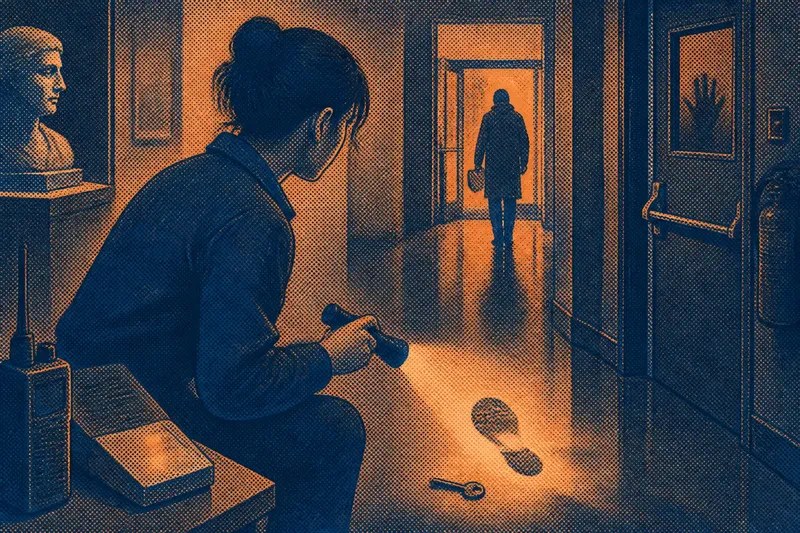
Mystery or thriller suspense turns on what a scene asks you to watch for: a hidden explanation or an approaching consequence. A film can use the same dark corridor for both, but clues invite interpretation while urgent danger makes you anticipate what may happen next.
That distinction helps with films that do not fit neatly into one genre. The useful question is not whether a story contains a chase or a concealed identity, but which uncertainty organises the scene.
One corridor, two questions
Imagine a hypothetical film about Mara, a night caretaker at a small museum. After closing, she finds a wet footprint beside a locked archive room, though the entrance hall is dry. A recorded message from the curator says, “Don’t let anyone leave with the blue file.”
In a mystery version, Mara has time to inspect what happened. The main question is, “Who entered the archive, and why?” The footprint, a missing key and the curator’s oddly specific message become clues whose significance depends on how they might fit into an explanation.
In a thriller version, the immediate threat is clearer: a guard is trapped behind the archive’s fire door, and a figure is heading towards the museum exit with the blue file. Mara must choose between pursuing the figure and helping the guard. The viewer may still wonder who the intruder is, but the pressing question is what will happen before she acts.
The setting and objects remain the same. The mystery draws attention towards a hidden cause; the thriller pushes it towards an approaching consequence.
Clues and consequences
A clue is a detail that helps answer a question about an event, a person or a motive. A thriller may use clues too, but suspense often comes from what a character must do with limited time or incomplete knowledge. One form invites the viewer to interpret; the other commonly asks the viewer to anticipate.
In the museum mystery, the wet footprint matters because it conflicts with the dry entrance hall. A shot showing its direction might suggest that someone came from the archive rather than the street. The viewer can compare this detail with earlier evidence and revise a theory.
In the thriller version, the footprint might mark the intruder’s route right now. If Mara hears a door swing shut and runs towards it, the detail serves the pursuit. Attention shifts from “What does this prove?” to “Can she catch up?”
Neither genre is defined by whether the audience knows more than a character. A mystery can let viewers spot a clue before the investigator does, creating dramatic irony; a thriller can keep viewers as uninformed as its protagonist. The distinction lies in the kind of question that remains active.
Film form and attention
Suspense depends on more than plot. Framing, editing, sound and performance steer the viewer towards interpretation or anticipation, often without announcing the genre.
A mystery scene might hold on the room after Mara leaves. The empty frame invites a second look: perhaps a drawer is open, a glass has shifted or a reflection reveals something she missed. A measured cut leaves time to connect details; silence can make a faint mechanical click seem significant.
A thriller might cut between Mara, the moving figure and the trapped guard. Each change clarifies the immediate situation, while an alarm or approaching footsteps makes delay feel costly. Tight framing can restrict what Mara sees; a glance towards an exit can turn the corridor into a route with a deadline.
These are tendencies, not rules. A long take can feel urgent if a threat advances within it, while rapid cutting can scatter clues in a mystery. Ask what the film encourages you to do: inspect and infer, or track movement, weigh risk and expect a collision.
A shifting genre balance
Films can shift between mystery and thriller from scene to scene. Mara might begin by investigating the footprint, then hear the guard calling for help and act without knowing who entered the archive. In the first passage, explanation leads; in the second, a decision under pressure takes over.
That shift need not mean the film has changed genres. The viewer may want to know who took the file and fear that the guard will be harmed. Suspense deepens when the answers connect: identifying the intruder may reveal the danger facing the guard.
For close viewing, notice which question survives a cut. If the film returns to Mara studying the lock, it may be asking you to interpret evidence. If it cuts to the figure nearing the exit while Mara hesitates, it asks you to feel the cost of delay. Both effects can overlap, though one often leads.
It is not worth forcing every scene into a single label. A locked room, a chase or a concealed identity does not decide the genre by itself. Look instead at what the film makes visible, what it postpones and what it makes urgent.
Questions about suspense?
Can a film be both mystery and thriller?
Yes. A film can build a puzzle about who caused an event while also putting characters in immediate danger. The scene leans towards mystery or thriller according to whether explanation or urgent consequence carries more weight.
Does a mystery need a detective?
No. The investigator may be an amateur, a witness or the viewer. What matters is that the story gives attention to evidence and the gradual formation of an answer.
Does a thriller need a ticking clock?
No literal countdown is required. A closing escape route, an approaching pursuer or narrowing choices can create urgency without a clock appearing on screen.
Why can a known outcome still feel suspenseful?
Knowing what will happen does not settle how a character will reach it, what it will cost or whether a particular danger can be avoided. Suspense can come from watching consequences approach even when the broad outcome is no longer a mystery.
A viewing test
Return to Mara’s museum scene and ask what you would notice first. If your attention goes to the footprint, key and message as parts of a possible explanation, mystery suspense is leading. If you watch the exit, the guard and the shrinking chance to intervene, thriller urgency is doing more of the work.
Try the same test during a film: name the question holding your attention, then notice how camera and sound keep it active. Mystery or thriller is not merely a label for a plot; it describes how a film directs curiosity, apprehension or both.
A reveal and a rescue can satisfy in different ways. A reveal makes scattered details click into a coherent account; a rescue resolves pressure that has been building in the present. When a film earns both, its final answer can also change how you understand the danger you have just watched.